
 Search
The Diamond Chain Calculator
Any diamond, any cut, from a 1 pointer to 100 carats, next to a real quarter.
Size your diamond chain
Drawn to scale with the quarter.
Hold a real quarter flat on your screen, over the coin. Tap Smaller or Bigger until the coin on the screen matches it.
- Stones per inch
- 5.7
- Stones in the chain
- 125
- Total carat weight
- about 31 carats
- Chain width
- about 4.5 mm
Bigger than any stone in our case today. We make custom pieces.
See every tennis chain →How the math works: a round diamond's width follows its weight, and the other cuts follow the outlines in our diamond size chart. On our own tennis chains, the stones sit about 1.1 stone-lengths apart and the chain runs about 0.4 mm wider than the stone; other cuts are counted set end to end. Every maker's setting is a little different, so each listing's own carat weight is the number you buy. Two chains with the same stones can differ a lot in price: the gold in the casting is most of the difference. The quarter is a US Mint photo; the diamonds are AI images, drawn to size.
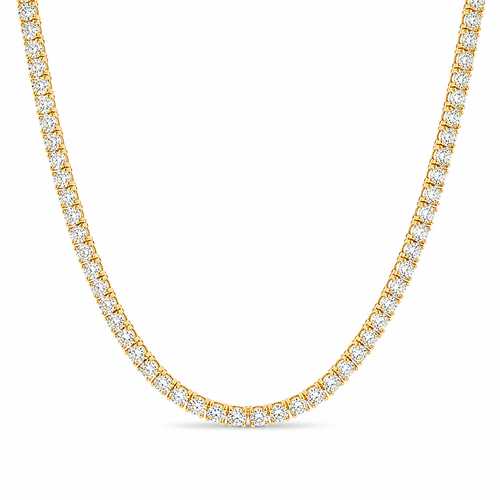
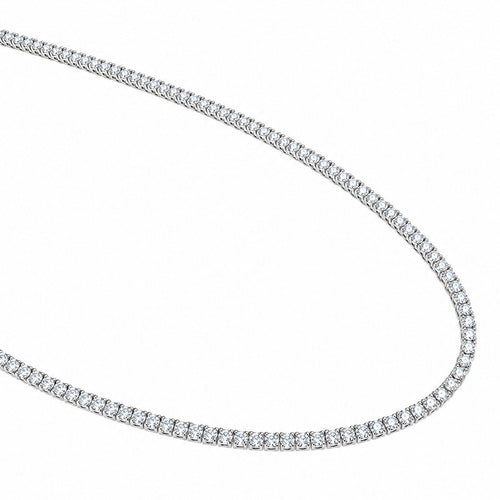
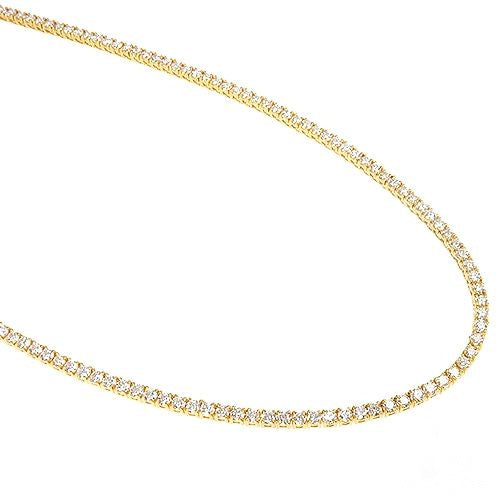
Most diamond chains are bought off a photo and a carat number. The calculator above turns that number into something you can see: the stone next to a quarter, how many stones fit in an inch, and how many carats the whole chain carries, with the chains in our case closest to that size and their prices today. The chains under it are real pieces in our case; the diamond pictures are AI images, and the quarter is a US Mint photo.
What a pointer is
Jewelers count diamonds in points: 100 points make one carat. A 10 pointer is a tenth of a carat, a 25 pointer is a quarter carat, and a 50 pointer is half a carat. On a tennis chain, the pointer size of each stone sets everything else: how wide the chain is, how many stones fit in an inch, and the total carat weight.
| Stone | Carat each | mm across | Per inch | 20″ chain | 22″ chain |
|---|---|---|---|---|---|
| 3 pointer | 0.03 | 2.0 | 11.5 | 6.9 | 7.6 |
| 5 pointer | 0.05 | 2.4 | 9.7 | 9.7 | 10.7 |
| 7 pointer | 0.07 | 2.7 | 8.7 | 12.1 | 13.4 |
| 10 pointer | 0.10 | 3.0 | 7.7 | 15.4 | 16.9 |
| 15 pointer | 0.15 | 3.4 | 6.7 | 20.1 | 22.2 |
| 20 pointer | 0.20 | 3.8 | 6.1 | 24.4 | 26.8 |
| 25 pointer | 0.25 | 4.1 | 5.7 | 28.2 | 31.2 |
| 30 pointer | 0.30 | 4.3 | 5.3 | 32.1 | 35.1 |
| 50 pointer | 0.50 | 5.1 | 4.5 | 45.0 | 49.5 |
| 75 pointer | 0.75 | 5.9 | 3.9 | 59.2 | 64.5 |
| 1 carat | 1.00 | 6.5 | 3.6 | 71 | 79 |
The 20″ and 22″ columns are total carats in the whole chain. The table is for one row of round diamonds in four prongs, the way our tennis chains are set. We checked it against our own chains: by the table, a 20 pointer chain at 22 inches carries about 27 carats, and two of our chains at that size carry 26.0 and 26.3. Each listing states its own carat weight, and that is the number you buy.
Natural diamond chains, made the right way
Run those sizes through the calculator. A 22-inch chain of 25 pointers is about 125 stones and 31 carats; of half carats, about 99 stones and 50 carats; of one carats, about 79 stones and 79 carats. Every natural stone in a chain like that has to match the others in color and clarity, and the matching is where the price goes.
Lab-grown: the shine without the million dollars

A lab-grown diamond is a real diamond: the same carbon crystal, as hard and as bright as a mined one, grown above ground instead of dug up. VVS means very, very slightly included, with flaws you can't find without strong magnification. That is Trax's point: with lab-grown stones, VVS at chain sizes is within reach, and much of what you pay for is the gold. For the full comparison, read lab-grown or natural and what VVS means.
How Trax checks a diamond chain
Three checks are in that answer.
- The tester. A diamond tester tells a diamond from a fake. A basic heat tester can pass moissanite as a diamond; a tester that also reads electrical current catches it. A standard tester can't tell lab-grown from natural, because both are diamond: that takes lab equipment, and the proof is a report from GIA or IGI.
- The casting. Under a loupe, every stone sits level, every prong holds its stone, the links bend freely, and the clasp closes with a safety.
- The price against the stones. Count the stones and the carats with the calculator above. A chain priced far below what its carats and gold should cost tells you to test it before anything else.
More you can check at home: how to tell if a diamond is real, and the setting, prongs and clasp in our diamond tennis chain guide.

Read next
- Diamond tennis chains: stone size, prongs, clasp
- Lab-grown or natural: how to tell, and what sets the value
- How to tell if a diamond is real
- Diamond size chart: carat to millimeters
- VVS diamonds: what VVS means
- The Chain Atlas: ten gold chains photographed side by side
Before you buy
The chains in this story, and the guides from the store


